

Hello everyone! Wall Street is coming off a very trying week, with the Nasdaq falling for five consecutive sessions. On the trading floors, one question is starting to loop: are we experiencing an artificial intelligence bubble? This week, all eyes will be on one major event: the big U.S. jobs report, to be released this Thursday. I’ll explain why it’s so crucial and why you won’t want to miss it.

The Dollar, Our Barometer for the Week
For me, the indicator to watch very closely this week is the dollar. You can think of it as a tide that lifts or sinks U.S. assets. Last week, it reached its highest level in 13 months. The reason is simple: the U.S. central bank (the Fed) is taking a tougher stance and considering raising its rates.
Naturally, when a rate hike is on the horizon, financial flows come in. Investors buy dollars to invest them for a better return. The mechanism is simple: the higher the dollar goes, the more it means the markets are anticipating a rate hike by the Fed.
And a rate hike is generally not good news for stock markets. Especially for tech, which needs to borrow billions to finance its growth. A small increase of 0.25% or 0.50% on 100 billion in loans amounts to tens of millions of extra dollars to pay each year. It adds up very quickly. A strong dollar also makes commodities more expensive for the rest of the world, as oil or copper are paid for in dollars. It is therefore inflationary.
The Deciding Factor: The U.S. Jobs Report
The entire week hinges on one event: the U.S. jobs report this Thursday. It has been moved up by a day because of the 4th of July, the American national holiday, which falls on a Saturday this year, making Friday a public holiday. We expect around 170,000 job creations.
Why is this figure so explosive? Because the context has changed. For years, we were accustomed to rate cuts. Today, the Fed is considering hikes to control inflation, which remains above its target.
If the United States creates a lot of jobs, it’s a sign that the economic engine is running at full throttle, or even overheating a bit. It is therefore an inflationary sign. To attract the best engineers or even a good baker, companies must offer better salaries and benefits. When wages rise, people spend more, which further fuels inflation. This is why the Fed is on its guard.
My Technical Analysis of the Main Indices
A quick overview of what I’m watching on the charts.
NASDAQ: Support Under Pressure
On the NASDAQ, I talked a lot about the 'monthly middle S1' last week. It’s an important support level. We’ve seen several bounces off it, but be careful, the buyers' reaction seems to be getting weaker with each touch. So, we must be cautious. The potential trade would be to wait for a clean touch of this level, or even slightly below, to try to play a quick re-integration.
European and American Indices: A Contrasting Picture
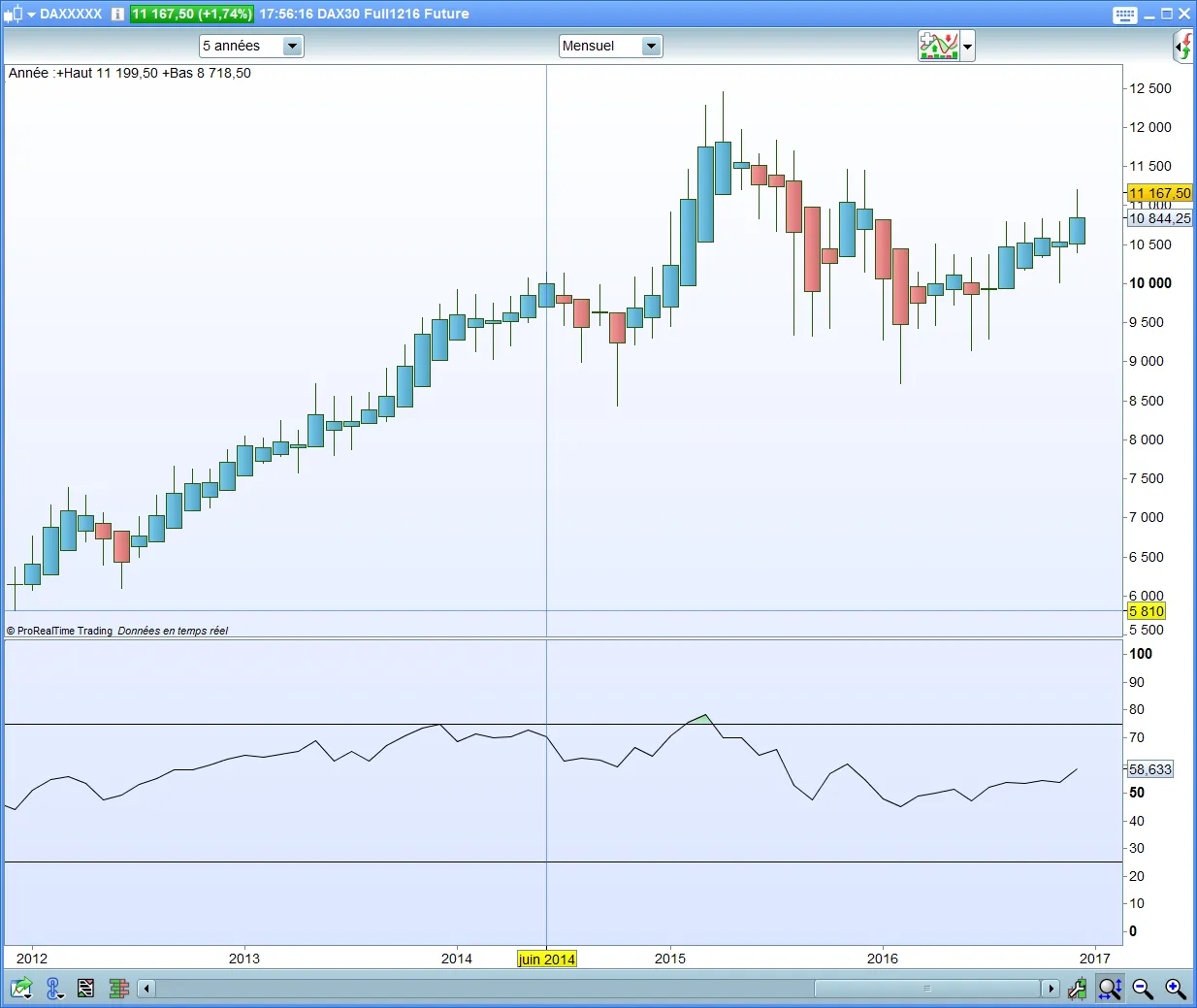
On the CAC 40, the situation is somewhat similar with a monthly resistance that has worked well. It’s holding up quite well near its recent highs. The DAX, on the other hand, shows a slight downward trendline; an area where sellers might wake up. What’s interesting is the contrast with the Dow Jones. While the Nasdaq was suffering, the Dow Jones hit its all-time high. You can’t say it’s doing poorly when it’s less than 1% from its historical peak!
Bitcoin and Gold: A Wait-and-See Attitude Dominates
For gold, not much is happening. It’s stabilizing around $4,000, without a clear signal. As for Bitcoin, it’s the same story. It has lost about 25% of its value in two months and is languishing near its annual lows. Despite calls from some, there is no real buying interest at the moment.
A Lesson from Alan Greenspan on Bubbles
I’d like to end on a more personal note. I was saddened to learn of the passing of Alan Greenspan, a finance legend. He was someone I admired intellectually, especially for his sharp and refined humor. He led the Fed for nearly 19 years and was nicknamed 'the Maestro.'
He left us a valuable lesson. In December 1996, during the rise of tech stocks, he used the famous phrase 'irrational exuberance of the markets.' In short, he thought the stock market was too expensive. Yet, the dot-com bubble continued to inflate for more than three years before it actually burst in 2001.
The moral is clear: spotting an excess is relatively easy. Everyone can see that there’s an excess in artificial intelligence right now. But knowing when that excess will end is absolutely impossible. Ponder on that.
Conclusion
For this week, caution will be our best ally. The markets will likely remain in a holding pattern, waiting for Thursday’s report, which could change everything.
Keep an eye on the dollar; it will set the pace. Remember this tricky loop: if the Fed raises rates, the dollar rises, which drives up commodity prices and therefore inflation… which could force the Fed to raise rates again. It’s not exactly a virtuous circle.
By starting the video, you accept YouTube's cookies.
Benoist Rousseau is a trader, member of the Chicago Mercantile Exchange (CME) and the Chicago Board of Trade (CBOT), an economic history specialist educated at the Sorbonne, and an experienced educator. He thus founded his Trading School in 2022.
With over 30 years of experience on CME futures, he shares market session analysis, commented trade replays, psychology and risk management — no signals, no promises, raw and unfiltered trading.





The complete course Free
Trading starts with the right tools.
- The complete course on the platform
- My Charts & Workspaces: exclusive access to my custom indicators, templates, and settings
- Guided configuration, step by step
When you are ready To go further
Courses, seminars, webinar, and private coaching. I accompany you personally.
Discover the School