
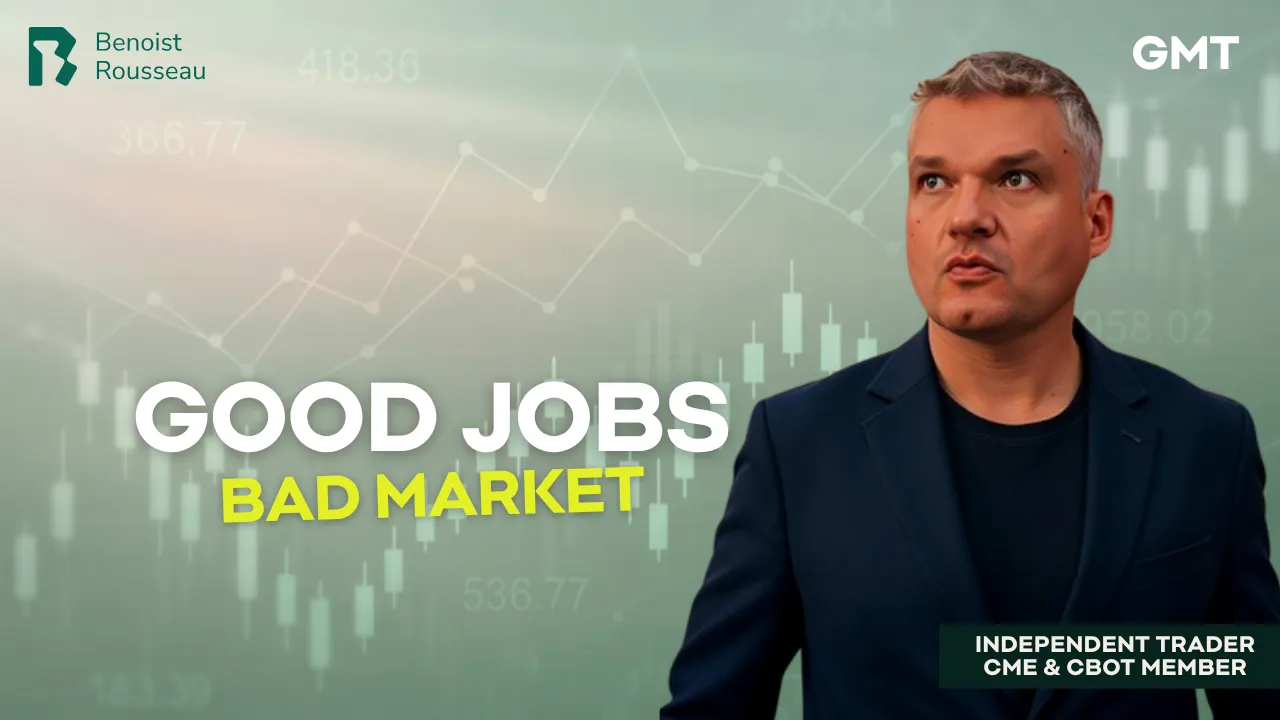

Wall Street just wrapped up a first half of the year with all-time highs, but a slightly strange question is set to dominate this week: what if good news for jobs scares the financial world? Right now, the usual logic is completely flipped. Everyone is waiting for the big U.S. jobs report on Thursday, and the mood is tense. I’m going to explain why this number is so important and how a positive situation can paradoxically become a risk for the markets.

A Historic Semester, But Personal Regrets
The quarter ended on a high note, especially on Wall Street. The S&P 500 gained 14% and the Nasdaq nearly 20%, driven by powerhouses like Nvidia or AMD. Just yesterday, the Nasdaq jumped 1.52%. I hope you capitalized on it better than I did.
Frankly, I ended the day in the green, but it could have been much better. Fatigue made me stick to my usual routine, when I should have been a bit more aggressive on a day like this. In short, whether the index gained 1.5% or 0.2%, I would have had the same score. A bit disappointed, yes, but you also have to know when to rest.
In Europe, it was a little less euphoric, even though the DAX and the Euro Stoxx performed well, catching up a bit.
The MOVE Index, an Indicator to Keep an Eye On
I’d like to tell you about a tool you may not be familiar with: the MOVE index. It’s the Merrill Lynch Option Volatility Estimate. Basically, it measures nervousness in the bond market. It’s an excellent complement to the more well-known VIX index.
Why am I talking about it today? Because we’re experiencing a surprising calm, at a 5-year low. The index is hovering around 68-70. To put it simply, the rule is as follows:
- Below 80: the bond market is sleeping soundly. Hibernation.
- Above 120: it’s a storm.
The MOVE index has been very good at signaling previous periods of turbulence, like Covid or the invasion of Ukraine. Today, it’s very low. Maybe a little too calm right before the jobs report is released… Perhaps that’s the trap. If this market wakes up, it could seriously shake up stocks.
The Jobs Paradox: When Good News is Bad News
Usually, strong employment is good news: more hiring, higher wages, leading to more consumption and growth. But this time, the logic is completely reversed. The FED is threatening to raise interest rates.
The reasoning is as follows: if the job market is 'too hot,' it fuels inflation. Why? Because people who find a job start spending. To fight inflation, the FED has only one effective macroeconomic tool: raising its rates. This discourages investment and consumption.
Uncontrolled inflation is dangerous. I like the image of Cronus, the ogre who devours his own children. If we let inflation soar, the first to suffer are the employees. Raising wages too quickly and too broadly is counterproductive. We saw it in France in 1981: a 10% wage increase was followed by a 12 to 13% price increase six months later. Purchasing power decreased.
This is why central banks watch inflation like a hawk. They aim for about 3%, a level considered dynamic for the economy, a bit like exercising gently but regularly: it’s beneficial in the long run.
The Scenarios for the Week
What could happen on Thursday?
- The ideal scenario: a moderate job creation number. In this case, "the party continues."
- The grim scenario: a "scorching" number, with 200,000 or 250,000 jobs created. In that case, the stock market might think, "Uh-oh, the FED is going to raise rates!", and equity markets could take a hit.
Not everyone agrees. Economists at Wells Fargo think the market is stabilizing. But the market itself is largely leaning towards one or two rate hikes before the end of the year.
A Little Anecdote About the Origin of This Famous Report
This jobs report hasn’t always existed. It was born out of the trauma of the Great Depression in the 1930s. After the 1929 crisis, people figured it might be useful to know how many jobs were being created or destroyed. Before that, the unemployed were counted haphazardly. It was following this great misfortune that modern economics really developed with people like Keynes or Hayek. It just goes to show, you can always learn lessons from crises.
By the way, I invite you to read American reports, especially those from the FED. They are surprisingly educational. They’re simple, clear, and anyone can understand them. The complete opposite of the ECB reports, which seem to be written specifically to make you feel completely stupid…
Conclusion
To conclude, caution is advised this week. Good economic news can quickly become bad news for the markets. We’re keeping an eye on today’s ADP survey, which will give us a first clue. Be careful, enjoy your day, and we’ll meet again tomorrow to analyze what comes next.
By starting the video, you accept YouTube's cookies.
Benoist Rousseau is a trader, member of the Chicago Mercantile Exchange (CME) and the Chicago Board of Trade (CBOT), an economic history specialist educated at the Sorbonne, and an experienced educator. He thus founded his Trading School in 2022.
With over 30 years of experience on CME futures, he shares market session analysis, commented trade replays, psychology and risk management — no signals, no promises, raw and unfiltered trading.






The complete course Free
Trading starts with the right tools.
- The complete course on the platform
- My Charts & Workspaces: exclusive access to my custom indicators, templates, and settings
- Guided configuration, step by step
When you are ready To go further
Courses, seminars, webinar, and private coaching. I accompany you personally.
Discover the School