
The Quaestor Edition: My Free Magazine for Traders Who Also Love Beautiful Things
The Quaestor Edition is my new digital magazine, quarterly and free: 128 pages for traders and economics enthusiasts who also have a taste for beautiful things. Here is what issue 0, The Edge, contains, why it costs nothing, and how to open it in a few seconds.
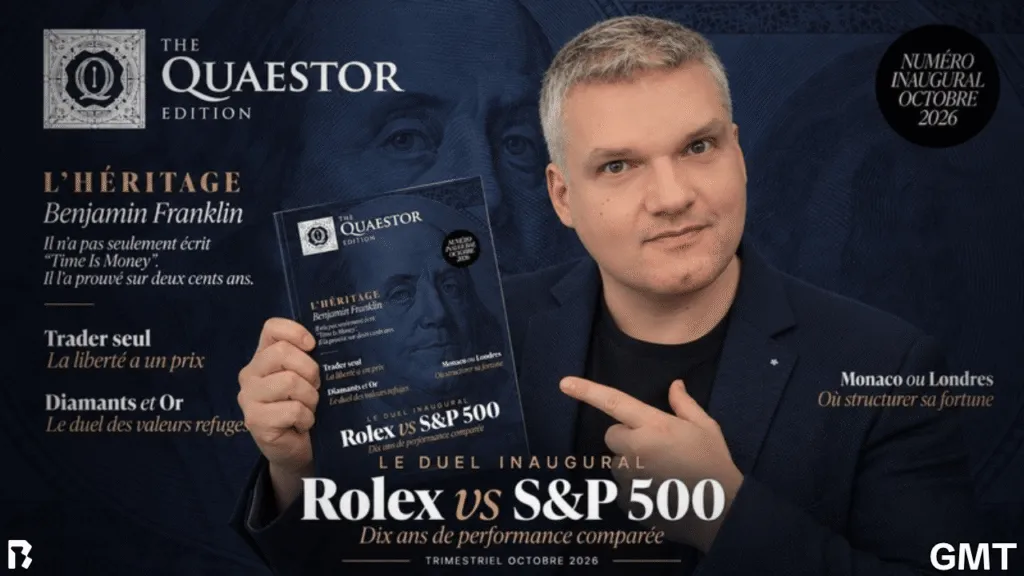

This project took me several months, if not several years. I wanted a level of quality beyond reproach, and a handful of beta readers, who leafed through it before anyone else, convinced me it was there. Issue 0 of The Quaestor Edition is now online. Here is what is in it, why it costs nothing, and how to open it in a few seconds.
By playing this video, you accept YouTube’s cookies.

The Quaestor Edition: What Kind of Magazine Is It?
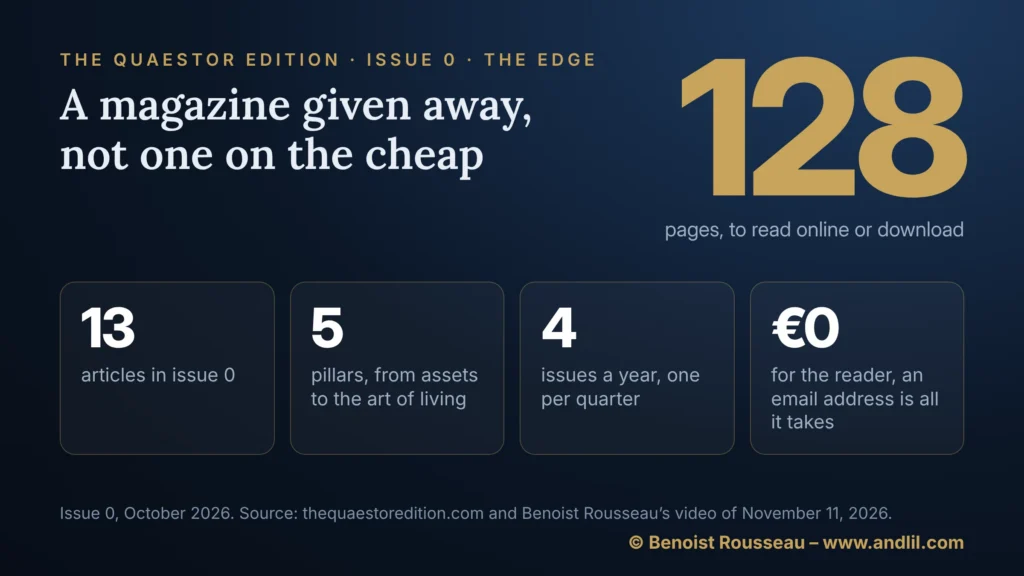
The Quaestor Edition is a free, quarterly digital magazine of 128 pages. It is written for people who manage, allocate, and pass on capital: traders, fund managers, independent investors. And, more broadly, for anyone who enjoys trading, economics, a good argument, and beautiful things. Issue 0 is called The Edge, as in the decisive advantage.
The name comes from Rome. The quaestor was the magistrate who guarded the treasury and rendered the accounts. That is a fair description of the job: keep what you have, and know where what you earn comes from.
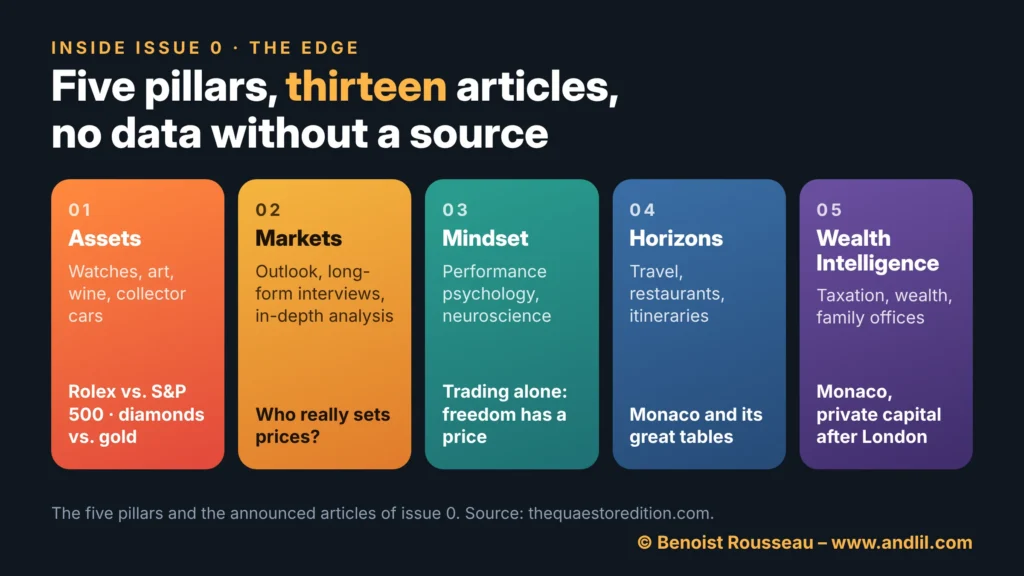
Issue 0 gathers thirteen articles under five pillars: Assets, Markets, Mindset, Horizons, and Wealth Intelligence. One editorial rule: no data without a source. It has been the rule on this blog since 2010, and it costs more than any layout ever will.
Why Is The Quaestor Edition Free?
Because I would rather have it read. A magazine of this standard could have sold for dozens of euros; I want it to stay free for as many readers as possible, for as long as possible.
There is a second reason, and it has nothing to do with accounting. Online, what travels fastest is rarely what deserves the trip. So I ask one thing in return: spread the word. Send the address to a friend, share it on your networks, email it to people you know. Giving away something beautiful has become rare enough to be a chance worth taking.
“Share what is beautiful. Online, all I see are people sharing absolute horrors or completely idiotic videos of guinea pigs or cats. Here, you have a chance to make someone happy.”
— Benoist Rousseau, video of November 11, 2026
Longtime readers know that the place money holds in our lives has been on my mind since the early days of this blog. A magazine given away is one answer among others.
What Is Inside Issue 0, The Edge?
Trading, the mind, economics, and the art of living, roughly in that order, with numbers every time. Here are the five pillars of the magazine and what issue 0 files under each one.
| Pillar | What it covers | In issue 0 |
|---|---|---|
| Assets | Watches, art, wine, collector cars, treated as real assets | Rolex vs. the S&P 500 over ten years; diamonds vs. gold |
| Markets | Market outlook, long-form interviews, in-depth analysis | Who really sets prices |
| Mindset | Performance psychology, neuroscience applied to trading | Trading alone: freedom has a price |
| Horizons | Travel, restaurants, itineraries | Monaco and its great tables |
| Wealth Intelligence | Taxation, wealth structuring, family offices | Monaco, where private capital goes after London |
The feature people will argue about compares a Rolex with the S&P 500 over ten years. The luxury watch market has fed plenty of wealth-building fantasies; the numbers are more sober. I will not give you the result: it is in the magazine. If the duel makes you wonder why anyone invests in financial markets at all, that is the point.
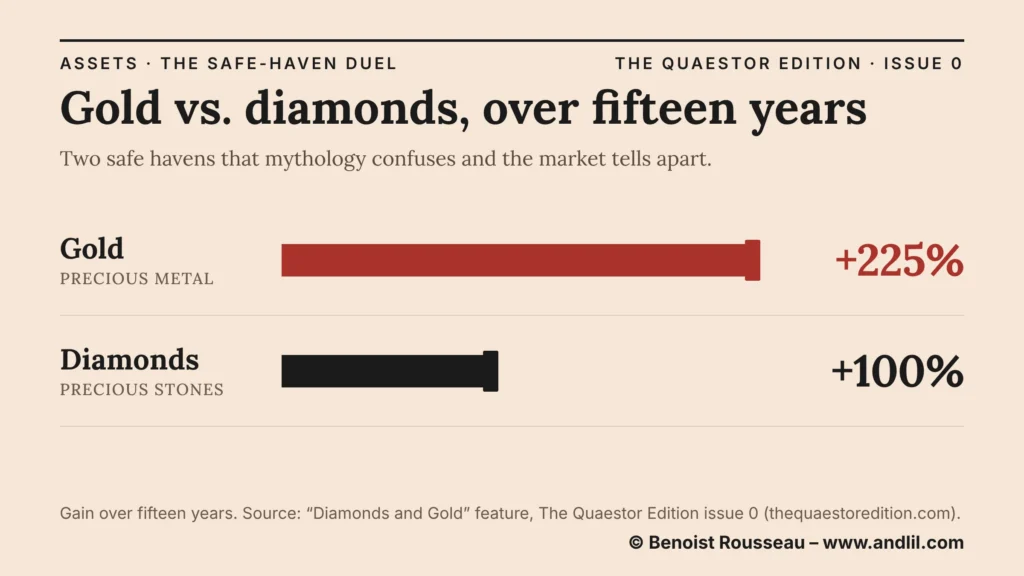
Gold and diamonds get the same treatment: two safe havens that mythology confuses and the market tells apart. Over fifteen years, according to the feature, gold gained 225% and diamonds 100%.
The Mindset pillar opens with an article I wanted unsparing: trading alone, freedom has a price. What neurology, twenty years of drawdowns, and a few exceptional traders have to say about it.
Science has started measuring that price. In 2008, John Coates and Joe Herbert followed seventeen traders on a London trading floor for eight days. Their testosterone ran higher on the mornings of good days; their cortisol rose with market uncertainty. A trader’s brain is not a calculator, which is exactly why it needs rules. If you are asking yourself whether you can make a living as an active trader, start there.
On the Markets side, a reflection on a question deeper than it looks: who sets prices? Friedrich Hayek answered it as early as 1945: nobody, and everybody. A price is the summary of information that no single person holds in full. The trader who forgets that ends up believing the market is wrong.
You will also meet Benjamin Franklin, who wrote to a young tradesman in 1748 to remember that time is money. And a feature on Monaco, where I spent some time last year. I fell for the place, its restaurants in particular; the magazine adds a more serious question: why so many large British fortunes have moved there.
How Do You Download The Quaestor Edition for Free?
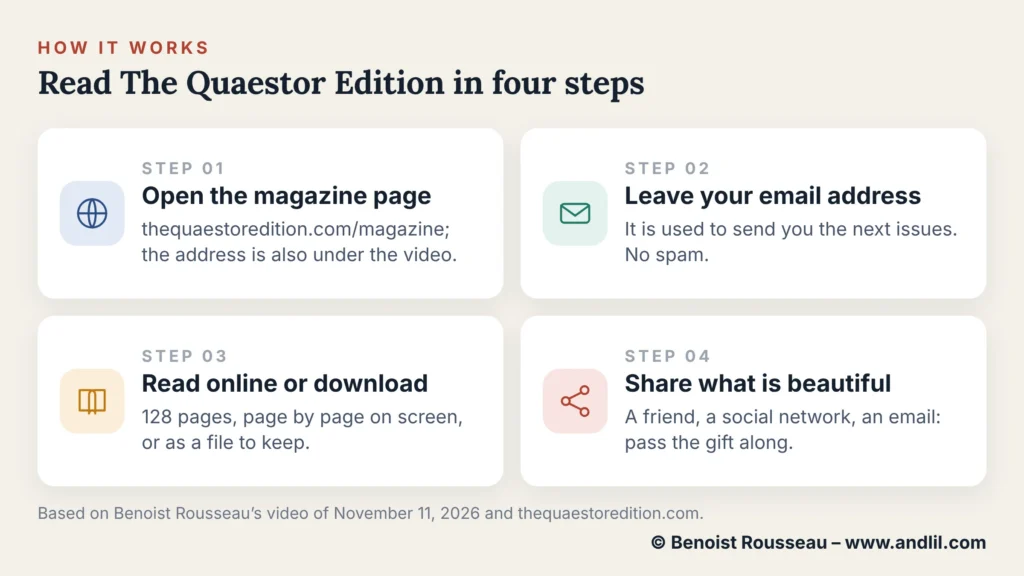
By leaving your email address on the magazine page, thequaestoredition.com/magazine. The issue opens right away: you can read it online, page by page, or download it to keep.
The address is also in the video description. The site promises “no spam,” and I intend to keep that promise: your address is used to send you the next issues, nothing else.
Who Is The Quaestor Edition Written For?
For traders first, and for everyone who enjoys trading, economics, thinking things through, and beautiful things, in that order or any other. I designed it for a reader who already has an opinion on the markets and likes being contradicted with numbers.
It will not teach you how to place an order. For that, there are books, the forum, and courses; those who want to go all the way with the method know that the “Devenez Trader Pro” program exists for that. The magazine does something else: every quarter, it gives you food for thought, a few lessons in trading psychology, and some good addresses.
I have been an active trader since 1994. What taught me the most was never the sessions; it was the reading between the sessions. The Quaestor Edition is a free trading magazine made for exactly those moments.
What Comes Next for The Quaestor Edition in 2027?
Four issues in 2027, one per quarter. Issue 0 was the trial run; the rhythm is set.
The topics of the next issues are also decided with you. Leave me a comment under the video with the themes you would like to see covered. And since it is a gift, pass it on.
Four ways to keep the magazine alive:
- Read it online, or download it to keep.
- Send the address to a friend who loves markets or beautiful things.
- Share it on your social networks or by email.
- Suggest a topic for the next issues, in the comments under the video.
Trading involves a high risk of capital loss.
Frequently Asked Questions
Is The Quaestor Edition really free?
Yes. You leave your email address on the magazine page and the issue opens, to read online or download. The address is used to send you the next issues, with no spam.
How many pages and articles are in issue 0?
128 pages and thirteen articles, spread across five pillars: Assets, Markets, Mindset, Horizons, and Wealth Intelligence.
How often does The Quaestor Edition come out?
Every quarter. Four issues are planned for 2027, after issue 0 in October 2026.
What does “Quaestor” mean?
In ancient Rome, the quaestor guarded the public treasury and rendered the accounts. The magazine takes up the office: question the markets, inform decisions, protect what matters.
Reference sources used
5
- The Quaestor Edition, “N°0 · The Edge, October 2026,” official site of the magazine, accessed November 11, 2026.
- Benjamin Franklin, “Advice to a Young Tradesman,” July 21, 1748, Founders Online, National Archives.
- F. A. Hayek, “The Use of Knowledge in Society,” The American Economic Review, September 1945.
- J. M. Coates and J. Herbert, “Endogenous steroids and financial risk taking on a London trading floor,” PNAS, April 14, 2008.
- S&P Dow Jones Indices, “S&P 500,” index factsheet.
Further Reading
- Marginalism: Understanding Value and Price in Economics, to go further on who sets prices.
- The Purpose of Financial Markets: Financing the Economy, the question behind the Rolex vs. S&P 500 duel.
- 10 Proven Trading Rules to Improve Your Market Performance, to go with the Mindset pillar.
Benoist Rousseau has been a trader since 1994 and is a member of the Chicago Mercantile Exchange (CME) and the Chicago Board of Trade (CBOT), where he holds two individual member seats. Founder of Andlil.com in 2010 and author of Devenez Trader Pro (2016), he has trained hundreds of traders at his trading school. In the “Market Session Analysis” section, he prepares the trading session ahead of the US open: key futures levels, gold, oil, and the economic calendar, without signals or promises.
Discover my backgroundThe complete course Free
Trading starts with the right tools.
- The complete course on the platform
- My Charts & Workspaces: exclusive access to my custom indicators, templates, and settings
- Guided configuration, step by step
When you are ready To go further
Courses, seminars, webinar, and private coaching. I accompany you personally.
Discover the School