
Trading Indices vs Stocks: The Nvidia Lesson in Single-Stock Risk
Nvidia lost more than $470 billion in two sessions over its CEO’s private affair, while the S&P 500 slipped just 0.4%. Benoist Rousseau, active trader since 1994, explains what that teaches about trading indices vs stocks, the Fed’s next move, and a night scalp on the Nasdaq.
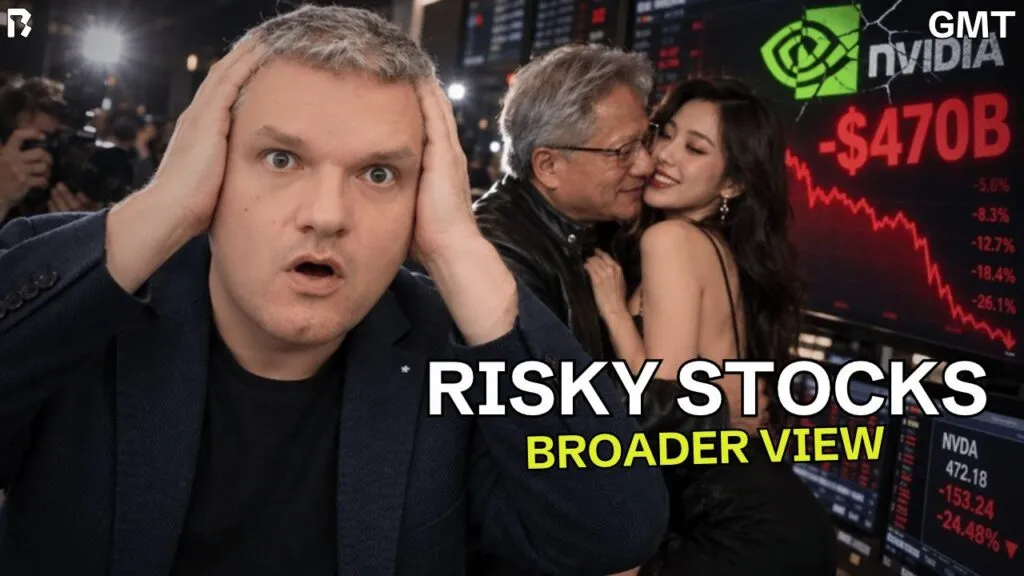

It was 2:42 a.m., Paris time, on November 11, 2026, when I recorded this Good Morning Trading. In New York, it was still the evening of the 10th. I had just traded. I sensed a bullish push coming on the Nasdaq. It came, I took my profit, and I was heading to bed.
Meanwhile, Nvidia had lost more than $470 billion in two days, over a story that had nothing to do with its chips: a textbook lesson in single-stock risk. I’ve been an active trader since 1994, and it’s the right moment to explain why I prefer to trade indices rather than individual stocks.
By playing this video, you accept YouTube’s cookies.

Trading indices vs stocks: why choose the index?
Because an index is an average: when one company collapses for an unforeseeable reason, its fall is diluted among all the others. On a single stock, nothing cushions the blow.
It’s the old principle of diversification: don’t put all your eggs in one basket. A stock carries two risks. The first is the risk of the whole market. The second belongs to the company itself: its management, its accounts, its CEO. You can measure and hedge the first. The second arrives without warning. I laid out the broader case in why trading indices suits active traders.
Take a simple, hypothetical example. You hold $100,000 of an excellent stock. One morning, the news breaks that the CEO has a turbulent private life, which has nothing to do with the company’s accounts. The stock opens 20% lower: you’re left with $80,000. On an index, the same scandal would have cost a fraction of a percent. Trading indices means accepting less spectacular moves; that is exactly what protects you.
Sizing each position is the other half of the job, as explained in money management for traders.
Nvidia stock: how did a scandal erase $470 billion?
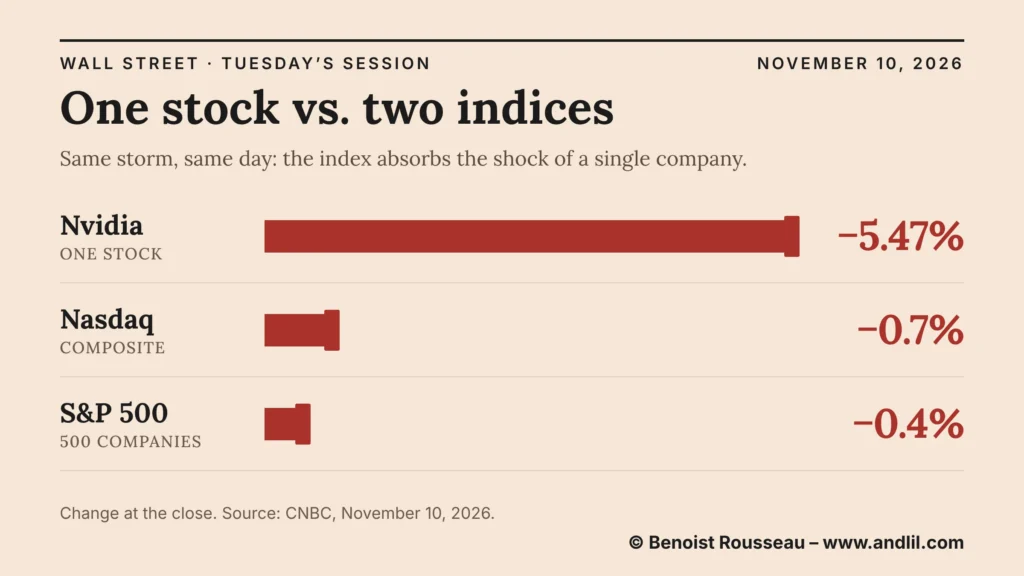
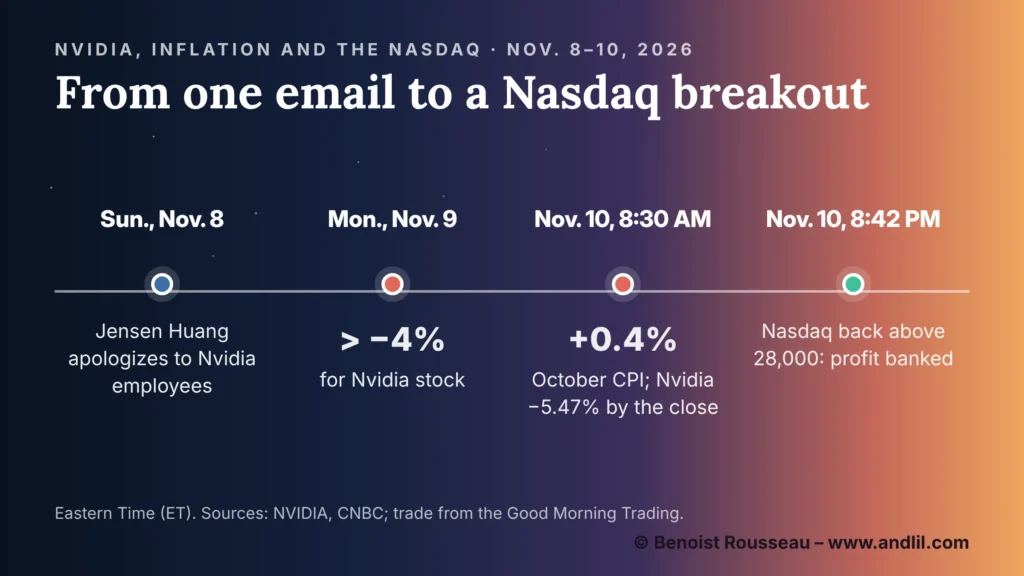
In two sessions, on November 9 and 10, 2026, Nvidia lost more than $470 billion in market capitalization, according to Reuters. The stock fell more than 4% on Monday, then 5.47% on Tuesday.
On Sunday, November 8, Jensen Huang, Nvidia’s founder and CEO, acknowledged in an email to employees that he had been unfaithful to his wife, and he apologized.
The story doesn’t end there. The businesswoman in question is suspected of spying for Beijing. The board has opened an independent investigation, and the FBI is examining whether Huang was the target of a foreign intelligence operation. At this stage, these are suspicions and investigations, not conclusions.
My reading, and it is only a hypothesis: China has every interest in weighing on sales of artificial intelligence chips, whose export Washington restricts. These chips are what the coming decades will be fought over. While some governments hunt for a few billion to balance their budgets, Nvidia lost 470 billion in two days. Its shareholders picked up the tab. The earlier chip crash had already shown how fast this sector can turn.
| Name | Type | Daily change |
|---|---|---|
| Nvidia | A single stock | −5.47% |
| Nasdaq Composite | A broad index | −0.7% |
| S&P 500 | 500 large companies | −0.4% |

That same Tuesday, the Nasdaq Composite lost 0.7% and the S&P 500 0.4%. Nvidia carries a heavy weight in both indices, and it dragged them lower. But an index is also hundreds of other companies with nothing to answer for. That one session sums up trading indices vs stocks.
October CPI: will the Fed raise rates in December?
That is now the most likely scenario. The US consumer price index (CPI) rose 0.4% in October, when economists expected 0.3%.
One tenth of a point, you might say, isn’t much. But the Federal Reserve watches this number very closely, and the market had been warned that same morning.
In London, a few hours before the release, Fed Governor Christopher Waller said he would still support a 25 basis point hike in December, even if inflation improved in October. He added that a 50 basis point hike “should be considered” if core inflation ran around 0.3% a month. Core inflation came in at exactly 0.3%.
In other words, the hike is coming, even if the rate hike itself is rarely the real story. Fed decision days are never quiet evenings; I learned that the hard way, as told in my losing evening around a Fed decision. The 10-year Treasury yield climbed back toward 5%, and money started to move.
CAC 40, DAX, Dow Jones, Nasdaq: what are the indices saying?
They don’t all say the same thing, and France’s CAC 40 is doing best. On my chart, the Paris index stands at a two-month high.
The paradox is a delicious one. The CAC 40 holds almost no tech stocks, so it escapes the storm shaking the chipmakers. It’s the revenge of old-economy companies, and a little of old Europe.
I told you: as long as it stays above 8,000 points, that’s a rather good sign. I’m only half pleased. Not having a single major AI company is no guarantee for the future. Rest assured, the race for AI dominance won’t be decided in Europe.
Germany’s DAX is nearing its high of the year. To buy it again, I’d want it to clear the previous week’s high; buying at the top looks risky to me. If the index is new to you, here is the history and composition of the DAX. The Dow Jones hasn’t moved in two weeks. It sits right in the middle of its range, and the middle of a range is often a coin toss.
The Nasdaq 100, despite Nvidia, kept climbing overnight. The S&P 500 bounced off the previous month’s low, a rather good sign: the bearish phase may be over.
Elsewhere, gold is holding above $4,000 an ounce, which leaves some hope.
Bitcoin, for its part, took a beating. It fell below $73,000, its lowest since August, before bouncing off a monthly support. To me, this is simply a transfer of liquidity. With rates set to rise, some investors are selling Bitcoin to park their money in US Treasuries, which pay more. I described the same kind of shift in where the money goes when the Nasdaq slides.
Big monthly supports work remarkably well on Bitcoin. Oil, finally, is slipping, which is good news in the fight against inflation.
Scalping the Nasdaq: should you regret exiting too early?
No. In scalping, you take your points quickly and you don’t chase the ones you missed. Missing the end of a move is part of the job.
That night, on the Nasdaq 100 futures contract, I bought the breakout above 28,000 points. The market accelerated, and I got out around 28,016–28,018, just before 28,025, as a precaution. Why I scalp futures rather than CFDs is another story.
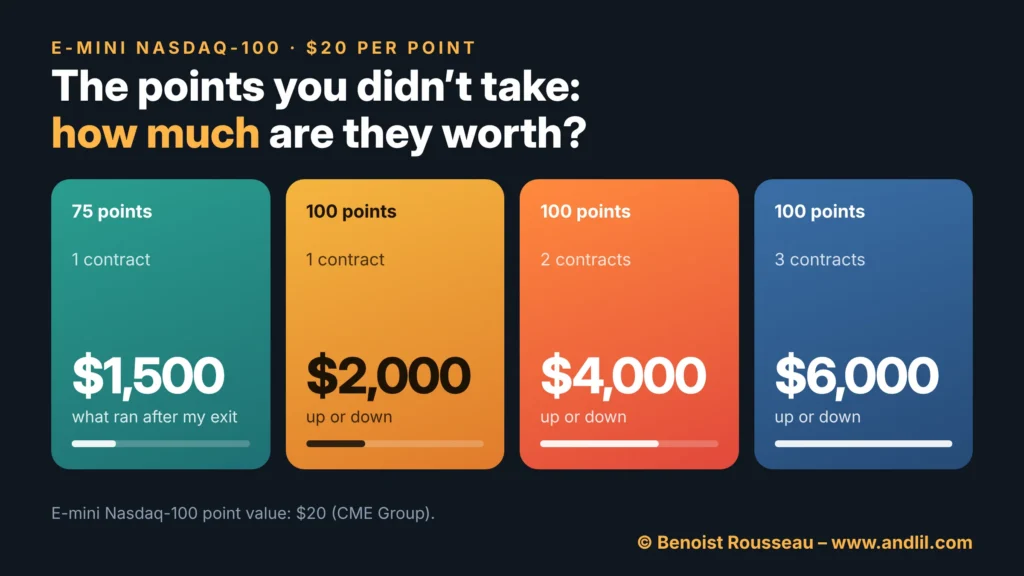
By the time I launched the video, the Nasdaq had added 75 more points. On the E-mini Nasdaq-100 contract, one point is worth $20: 75 points come to $1,500, and 100 points to $2,000 per contract. With two or three contracts, you can see where that goes.
Am I frustrated? Not at all. My only real disappointment of the session: I had planned to buy at 27,500 points, the week’s pivot point. Price came close, again and again, within a few points, then took off without me. It has gained more than 600 points since. Oh well.
Regret is one of the costliest biases a trader can have: if you refuse to miss anything, you end up entering anywhere. Controlling your emotions starts right there. I covered it in my piece on sector rotation and trading frustration.
“What’s taken is taken. Every single day I miss big moves, but that’s part of the deal with scalping.”
— Benoist Rousseau, Good Morning Trading, November 11, 2026
Consistency protects capital better than chasing the perfect trade. If you bank your gains every day, you are also less exposed to stocks that lose 5, 10, or 15% on some strange headline. Knowing where to place your levels, like that weekly pivot point, is a skill you can learn. It’s one of the topics we work through in detail in the “Devenez Trader Pro” course, if you want to go further.
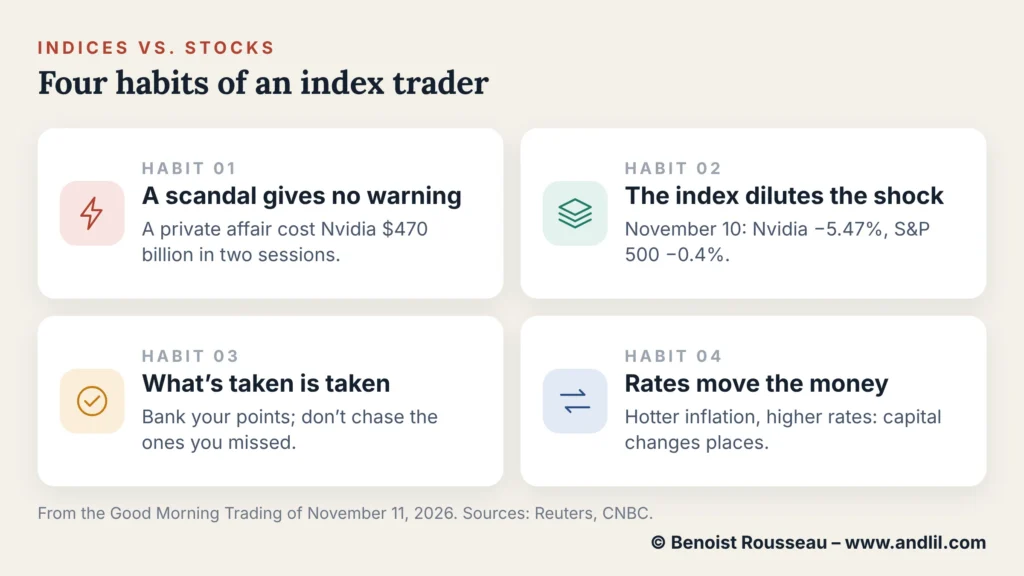
Trading indices vs stocks: a 6-point checklist
Six habits sum up how I approach trading indices vs stocks.
- Prefer an index to a single stock: a scandal, a lawsuit, or a weak earnings report weighs on it only in proportion to the company’s weight.
- Know what drives the index: Nvidia moves the Nasdaq, not the CAC 40.
- Before the session, write down the key levels: the previous week’s high and low, pivot points, monthly supports.
- Keep an eye on the calendar: an inflation print or a Fed decision moves money between stocks, bonds, and crypto.
- Take your gains without waiting for the last point.
- Never buy back, out of regret, a move you missed.
Trading involves a high risk of capital loss.
Frequently Asked Questions
Is trading an index less risky than trading a single stock?
An index removes the risk specific to one company: a scandal or disappointing earnings weigh on it only in proportion to that company’s weight. It remains exposed to the risk of the whole market, and the leverage of index futures can magnify losses as well as gains.
Why did Nvidia stock fall in November 2026?
After Jensen Huang acknowledged an affair with a businesswoman suspected of spying for China, the board opened an investigation. The stock lost more than 4% on November 9 and 5.47% on November 10, more than $470 billion in value in two sessions.
Why does hotter-than-expected inflation push Bitcoin lower?
Because it makes a rate hike more likely. Government bonds then pay more, and part of the money leaves assets that yield nothing, such as Bitcoin, to move into them.
How much is one point worth on the E-mini Nasdaq-100?
$20 per contract, according to CME Group’s contract specifications. A 100-point move is therefore worth $2,000 per contract, up or down.
Reference sources used
10
- NVIDIA Newsroom, “A Message to Our Company,” November 8, 2026.
- CNBC, “Nvidia sells off for second day in fallout from Jensen Huang’s affair with alleged spy,” November 10, 2026.
- Reuters, via Honolulu Star-Advertiser, “Nvidia heads for $470B wipeout amid CEO affair fallout,” November 10, 2026.
- CNBC, “S&P 500 falls, dragged down by Nvidia sell-off and rate-hike fears after hot inflation data,” November 10, 2026.
- CNBC, “Consumer prices rose 0.4% in October, more than expected, complicating Fed’s inflation fight,” November 10, 2026.
- Federal Reserve, Governor Christopher J. Waller, “The Economic Outlook and Some Thoughts on Labor Market Dynamism,” London, November 10, 2026.
- CNBC, “10-year Treasury yield races back to 5% as inflation data, Waller comments drive rate hike expectations,” November 10, 2026.
- CNBC Select, “The price of gold today, Nov. 10, 2026,” November 10, 2026.
- Forbes, “Bitcoin Falls Below $73,000 To Reach Lowest Since August,” November 10, 2026.
- CME Group, E-mini Nasdaq-100 contract specifications.
Further Reading
- My YouTube channels, where Good Morning Trading comes out every morning.
Benoist Rousseau has been a trader since 1994 and is a member of the Chicago Mercantile Exchange (CME) and the Chicago Board of Trade (CBOT), where he holds two individual member seats. Founder of Andlil.com in 2010 and author of Devenez Trader Pro (2016), he has trained hundreds of traders at his trading school. In the “Market Session Analysis” section, he prepares the trading session ahead of the US open: key futures levels, gold, oil, and the economic calendar, without signals or promises.
Discover my backgroundThe complete course Free
Trading starts with the right tools.
- The complete course on the platform
- My Charts & Workspaces: exclusive access to my custom indicators, templates, and settings
- Guided configuration, step by step
When you are ready To go further
Courses, seminars, webinar, and private coaching. I accompany you personally.
Discover the School