
Range-Bound Market: The Trap After Nvidia’s Surge
After Nvidia’s 31% jump, the Nasdaq froze in a range-bound market for hours. This article explains why price stalls after big news, how to trade the monthly support, and how to keep a losing scalp from blowing up an account.
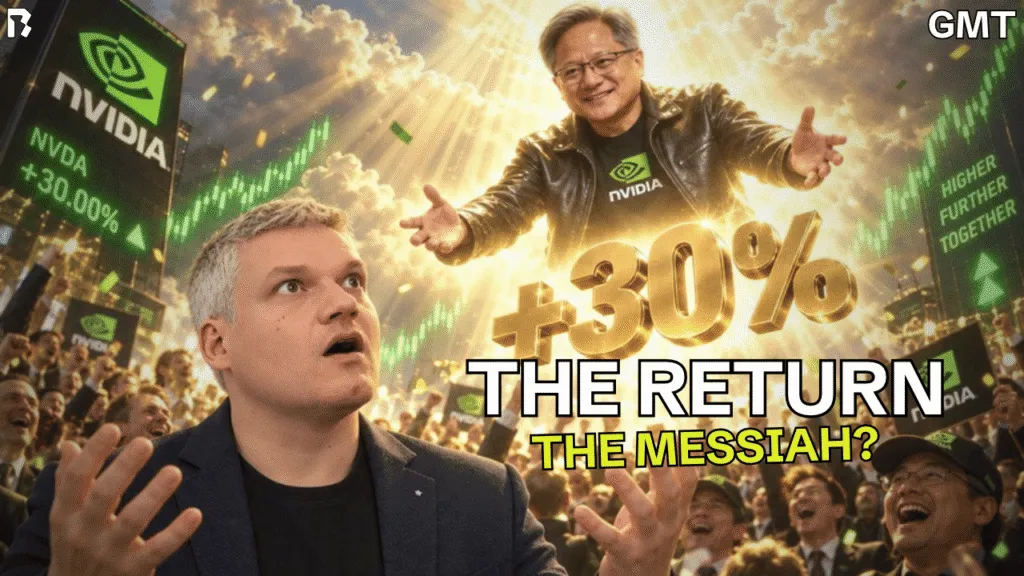

I never expected to see one man add nearly $1 trillion in market value in a single session just by returning to his desk. Yet that is what happened with Nvidia on Monday. But for a trader, the surge was not the most interesting part. What came next was: hours of going nowhere, the favorite hunting ground of every trap.
By playing this video, you accept YouTube’s cookies.

Nvidia Stock Surge: Why Did Shares Jump 31% in One Session?
Nvidia stock jumped 31% because its founder and CEO, Jensen Huang, came back to run the company. He had resigned in mid-November. On Monday, November 23, before Wall Street opened, the board unanimously reinstated him.
The stock closed up 31.48%. About $950 billion in market value came back in a single day. According to NBC News, that is the largest one-day gain in value ever recorded by a company. The most profitable comeback in stock market history: even the most eagerly awaited saviors never did better on a simple announcement.
The rescue came just in time. The previous Friday, the Nasdaq 100 had closed right at the edge of a bear market, almost 20% below its high. On Monday, the Nasdaq Composite rebounded 6.51%. The White House was not a bystander: the U.S. president, Donald Trump, said he had spoken to Nvidia’s board, directly and indirectly, and the company’s statement cites input from senior levels of the U.S. government.
The real criticism lies elsewhere. Before this departure, Nvidia had no board chair and no clear succession plan. Yet that is the first thing a company prepares. At Renault, the French automaker, CEO Louis Schweitzer announced as early as 2002 that he would hand over the reins in 2005 to Carlos Ghosn, the man turning Nissan around. The handover went as planned. At Nvidia, nothing was ready, as if the boss were immortal.
This is not the first time one company has moved the whole market. I described it during an earlier Nvidia earnings season, when a single report set the tone for the indexes.
Range-Bound Market: Why Does Price Stall After Big News?
After big news, price stalls because everyone has already acted. Those who wanted to buy did so in the first candle. Those who hesitate are waiting to see what comes next. Almost no one is left to push the price.
The market then settles into a trading range: it rises, falls back, rises again, without ever choosing a direction. That is exactly what the Nasdaq chart showed on Monday: one huge candle, then more than seven hours of going nowhere, and the whole night after that. I have seen these markets on hold before, and they always look calmer than they are.
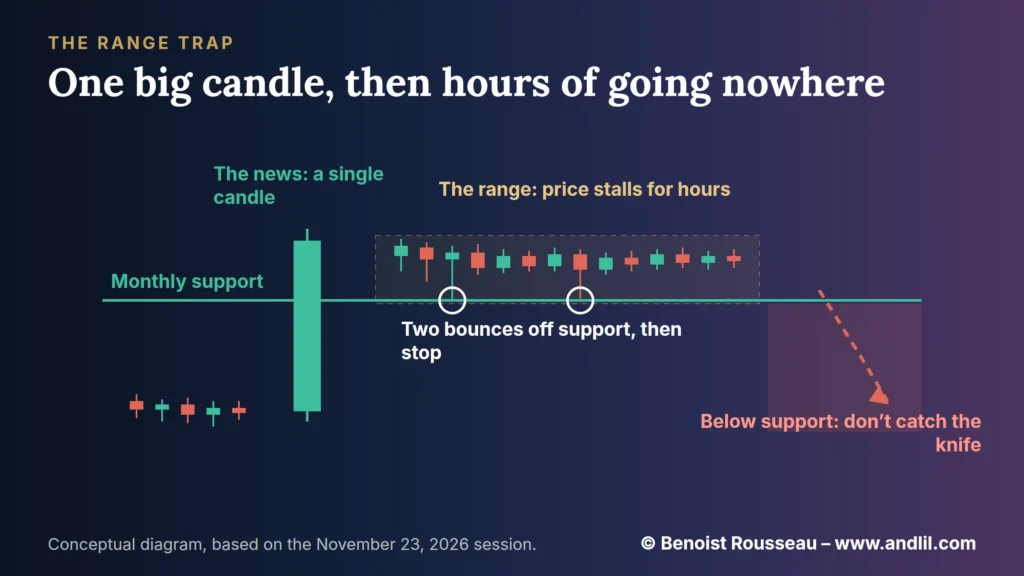
For an active trader, this is the hardest setup of all. Small breakouts go nowhere, stops get hit on both sides, and you end up trading out of boredom. The market no longer pays for patience: it tests it. That is also why breakout strategies fail so often in sessions like these.
Monthly Support: How Do You Trade a Range-Bound Market?
In a range-bound market, trade only the strong levels, and stop early. On Monday, only one technique worked: buying the bounces off the monthly support.
A monthly support is a level calculated once a month from the previous month’s prices, like pivot points. On Monday, it served twice as a bounce zone. After one or two round trips, the day was done. Pushing on after that means handing back to the market what it just gave you.
Be careful with your tools: not all software calculates these levels the same way. TradingView’s monthly supports, for example, do not fall in the same places as mine. Before you rely on them, check how they are calculated. For the rest, five simple rules:
- Write down the monthly supports and the edges of the range in the morning.
- Trade only when price touches those levels, never in the middle of the range.
- Aim for one or two bounces, then call it a day.
- Place a stop order before you enter, and never move it further away.
- Cut your size when volume drops.
Support Breaks in a Range: Should You Catch a Falling Knife?
No. If the support gives way and price cannot climb back above it, do not buy the dip. That is the famous falling knife.
A solid support steadies the market as long as it holds. But it also carries a huge risk. If it breaks, the buyers are no longer there to defend it, and there is often nothing below until the next level. Sellers may try to retest it from underneath: that is a game for scalpers, not an invitation to buy. If Monday’s support gave way, it would be a sign that the comeback effect is starting to fade.
“You have a position, it goes against you, you wait and hope it comes back, and it doesn’t come back.”
— Benoist Rousseau, Good Morning Trading, November 24, 2026
Nasdaq, Dow, Gold, and Oil: Where Do Markets Stand After the Rebound?
After Monday’s rebound, all the major indexes are in a holding pattern, just above their supports. The rebound is real, but it settled nothing: Nvidia stock is still about 30% below its October 6 record.
| Market | Close | Change |
|---|---|---|
| Nvidia stock | — | +31.48% |
| Nasdaq Composite | 24,089.56 | +6.51% |
| S&P 500 | 7,237.17 | +4.73% |
| Dow Jones | 49,595.31 | +3.01% |
The Dow, the Nasdaq, and the S&P 500 are holding above their monthly supports and trying to stay there. For the bigger picture of the last few weeks, see where the money goes when the Nasdaq slides. In Europe, Germany’s DAX rebound stalled at a monthly support, and France’s CAC 40, less spectacular, stalled at a previous high. Jensen Huang’s return matters less to French stocks.
Gold rebounded on Monday, but it remains weak. On the morning of November 24, it traded at $3,611.99 an ounce, about a third below its record of $5,589.38 set on January 28. On a Heikin Ashi chart, its candle is still red. This may be the time to give gold coins for Christmas: they cost far less than a few months ago, and no one will know.
Bitcoin, for its part, is trying to hold $60,000 after falling almost nonstop for two months. Oil keeps sliding, with WTI down another 2.8% during Monday’s session: good news for countries that import oil, bad news for producers.
From Scalping to Swing Trading: How Does a Range-Bound Market Blow Up an Account?
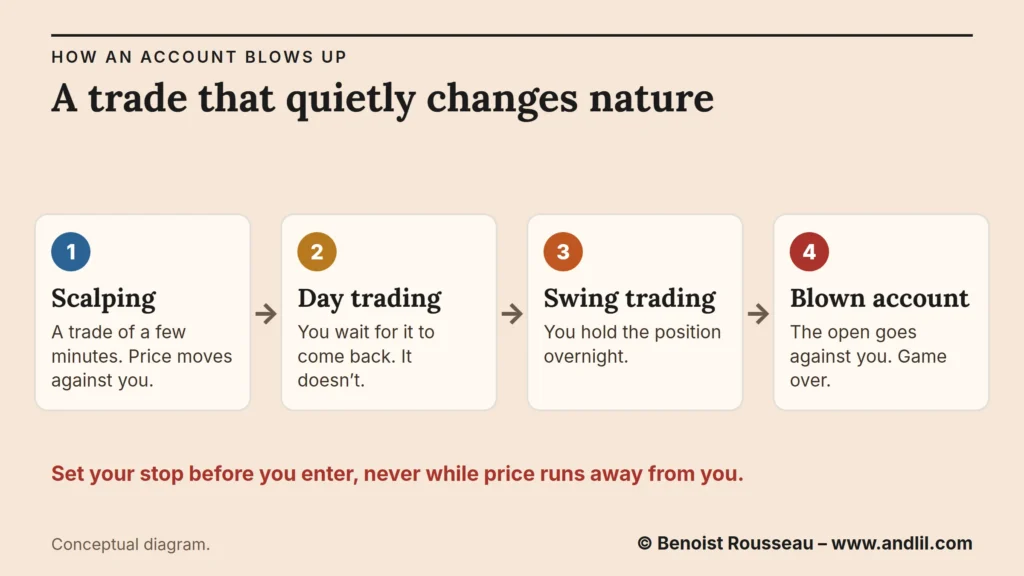
A range-bound market blows up an account when a position changes nature without you ever deciding it. It is the scenario I have seen most often in weeks like this one.
You take a scalp, a trade meant to last a few minutes. Price moves against you. You wait for it to come back, and it does not: your scalp becomes a day trade. In the evening, you hold the position overnight: your day trade becomes a swing trade. And in the morning, the open goes against you again. Game over.
This week makes the danger worse. It is Thanksgiving week: Wall Street is closed on Thursday and closes early on Friday. According to Russell Investments, U.S. equity volume typically falls to about 45% of normal the day after Thanksgiving. The same thing happens between Christmas and New Year’s Day.
With so few participants, a handful of orders can move a price violently. One nasty candle against you, and there is no way to recover. That is what liquidity risk means in practice, and it is why I prefer trading the indexes rather than a single stock.
Knowing when to stop and when to cut a trade are skills we cover in detail in my course “Devenez Trader Pro,” if you would like to go further. For this week, one piece of advice: be careful.
Trading involves a high risk of capital loss.
Frequently Asked Questions About Range-Bound Markets
What is a range-bound market?
It is a market that swings between a floor and a ceiling without picking a direction. Buyers and sellers cancel each other out, and price keeps returning to the same zone.
How do you know when a range is over?
You need a clean exit: a close well beyond the edge of the range, then a price that does not come back inside. A breakout that is quickly reversed is a false signal, common in markets with little volume.
Why did Nvidia stock soar 31% on November 23, 2026?
The board reinstated Jensen Huang, the company’s founder and CEO, who had resigned in mid-November. The stock gained 31.48% that day, or about $950 billion in market value.
What is a monthly support level?
It is a price level calculated once a month from the previous month’s prices, like a pivot point. Traders watch it because price often bounces there, as long as it does not break.
Reference sources used
11
- Nvidia, “NVIDIA Board Reinstates Jensen Huang as President, CEO and Board Director,” November 23, 2026.
- CNBC, “Jensen Huang reinstated as Nvidia CEO. Stock skyrockets 31%,” November 23, 2026.
- NBC News, “Stocks surge in best day since 2025, adding trillions in value after Jensen Huang returns to Nvidia,” November 23, 2026.
- CNBC, “Jensen Huang’s Nvidia exit exposes succession and governance risks for companies,” November 17, 2026.
- CNBC, “S&P 500 correction: What caused the market sell-off,” November 20, 2026.
- CNBC, “Stock market news for Nov. 23, 2026,” session of November 23, 2026.
- CNBC, “Oil drops on increased Middle East flows, Libyan pipeline restart,” November 23, 2026.
- CNBC, “Gold slips with spotlight on U.S. inflation data,” November 24, 2026.
- Russell Investments, “The holiday trading effect,” November 11, 2026.
- Time, “Carlos Ghosn, Renault: He Did So Well, Let’s Give Him Two CEO Jobs,” December 1, 2003.
- Renault Group, “Renault Group pays tribute to Mr. Louis Schweitzer, Chairman and Chief Executive Officer of the Group from 1992 to 2005,” November 7, 2025.
Further Reading
- My Take on a Two-Speed Market Ahead of a Risky Friday, on approaching a session that can turn against you.
Benoist Rousseau has been a trader since 1994 and is a member of the Chicago Mercantile Exchange (CME) and the Chicago Board of Trade (CBOT), where he holds two individual member seats. Founder of Andlil.com in 2010 and author of Devenez Trader Pro (2016), he has trained hundreds of traders at his trading school. In the “Market Session Analysis” section, he prepares the trading session ahead of the US open: key futures levels, gold, oil, and the economic calendar, without signals or promises.
Discover my background
The complete course Free
Trading starts with the right tools.
- The complete course on the platform
- My Charts & Workspaces: exclusive access to my custom indicators, templates, and settings
- Guided configuration, step by step
When you are ready To go further
Courses, seminars, webinar, and private coaching. I accompany you personally.
Discover the School