
Thanksgiving Week Stock Market: Why Is It the Riskiest of the Year?
The Thanksgiving week stock market offers only three full sessions on Wall Street, with the major data packed into Wednesday. Here are the 2026 hours, the calendar, and the precautions to take in a market that is already falling hard.

On Monday, November 23, I opened Good Morning Trading with a warning: this is the trickiest week of the year. Wall Street is open for only three and a half days. Americans have their minds on holiday sales. And a market that has been falling for weeks is starting to get scared. That is not a good combination.
By playing this video, you accept YouTube’s cookies.

Thanksgiving Week Stock Market: Why Is It So Risky?
The Thanksgiving week stock market is risky because it packs a lot of news into very few sessions, with fewer and fewer people around to absorb it. This year, it also arrives in a nervous market.
The first danger is liquidity. According to Russell Investments, U.S. equity volume typically drops to about 80% of normal the day before Thanksgiving, then to about 45% the day after. With fewer buyers and sellers, an ordinary order moves the price more.
The second danger is the calendar: most of the key U.S. data arrives on Wednesday. The third is the mood. We are in a very deep consolidation, not to say a slow-motion crash, and a frightened market reacts faster than it thinks.
“When Wednesday comes, tell yourself it’s the equivalent of Friday night.”
— Benoist Rousseau, Good Morning Trading, November 23, 2026
Stock Market Hours for Thanksgiving 2026: Which Days Can You Trade?
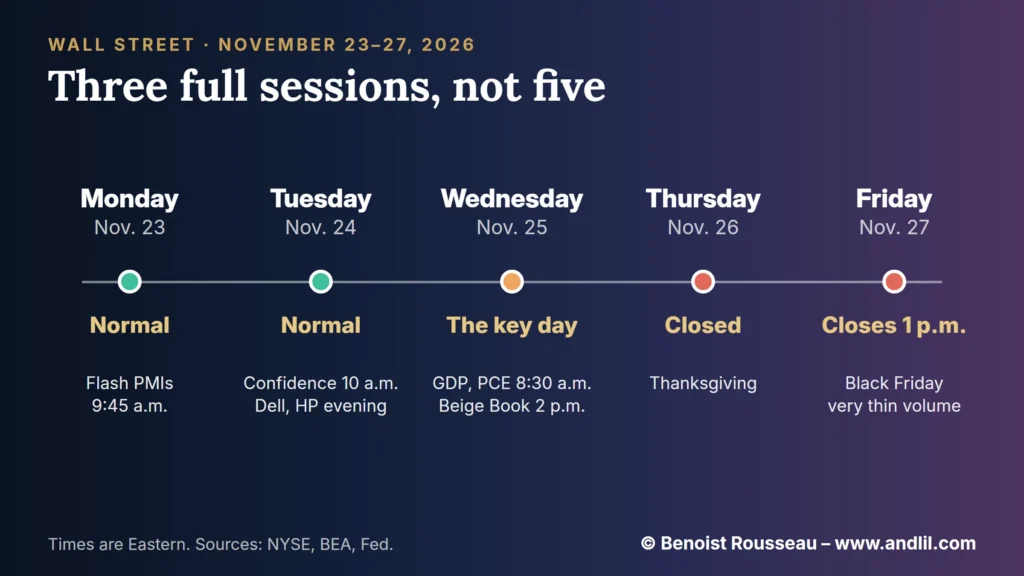
Wall Street trades normally on Monday, Tuesday, and Wednesday, closes on Thursday, November 26, then shuts at 1 p.m. ET on Friday, November 27. That is three hours earlier than usual.
That Friday is the famous Black Friday. On paper, the market is open. In practice, I suggest you treat it as a holiday: there are hardly any traders left, volume is very thin, and a move can mean nothing at all.
Thanksgiving Week Stock Market Calendar: What Should You Watch?
Watch Wednesday, November 25, above all, with U.S. GDP and the PCE index at 8:30 a.m. ET, then the Fed’s Beige Book at 2 p.m. ET. Monday and Tuesday are the warm-up, though they still carry two serious events for the indexes.
| Day | Wall Street | What to watch |
|---|---|---|
| Mon., Nov. 23 | Normal | Flash PMIs: Europe in the morning, U.S. at 9:45 a.m.; Zoom earnings |
| Tue., Nov. 24 | Normal | German ifo (4:30 a.m.), consumer confidence (10 a.m.), Dell and HP earnings in the evening |
| Wed., Nov. 25 | Normal | GDP, PCE, durable goods, jobless claims (8:30 a.m.), Beige Book (2 p.m.) |
| Thu., Nov. 26 | Closed | Thanksgiving |
| Fri., Nov. 27 | Closes at 1 p.m. | Black Friday, very thin volume |
On Tuesday, the market expects consumer confidence at 92.1, after 91.7 in October. That evening, Dell will get special attention: its numbers will show whether artificial intelligence passes the test.
On Wednesday, the key number is the PCE index, the inflation gauge the Fed watches. Its core version, excluding food and energy, is expected at 3.2% year over year, after 3.1%. Headline PCE is expected at 3.8%, after 3.6%. It is the last PCE report before the FOMC meeting of December 8–9.
The stakes are simple. The federal funds target range is 3.75% to 4%, and the market expects a quarter-point hike in December. The idea of a half-point hike has faded, but a PCE reading that runs too hot would put it back on the table. If you want a method for these releases, here is how I approach the Nasdaq, inflation, and your capital.
At 2 p.m. ET, the Beige Book describes the U.S. economy region by region. Do not confuse it with the FOMC minutes, the record of the October meeting, which came out on November 18.
Nasdaq, Dow, and Gold: Where Do Markets Stand Before Thanksgiving?
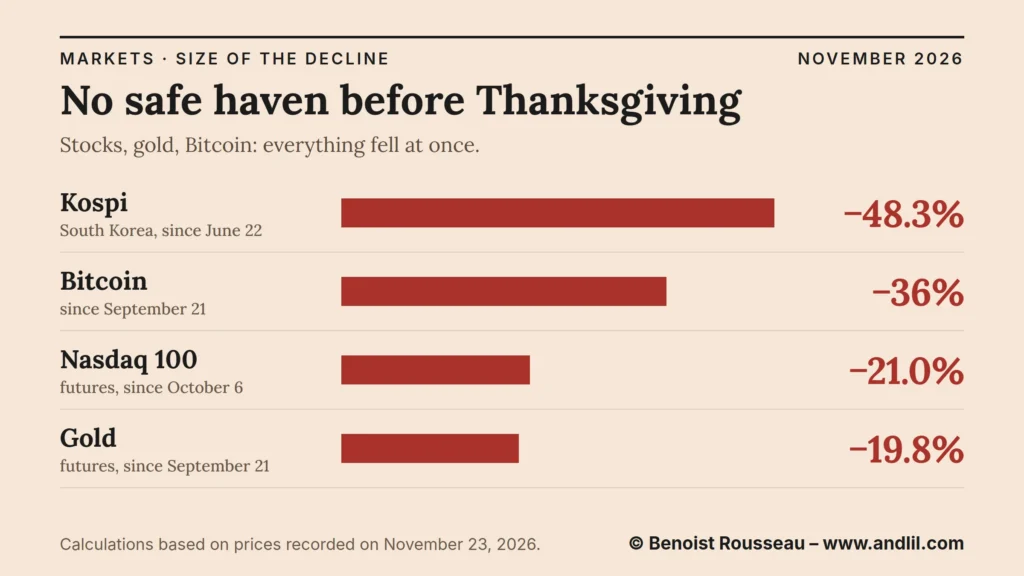
Markets reach Thanksgiving on red alert, nearly all of them close to their recent lows. Nasdaq 100 futures fell from 31,616.50 on October 6 to 24,976.50 on November 20. That is a 21% loss in less than two months.
| Market | Starting point | Low | Decline |
|---|---|---|---|
| Kospi (closing prices) | 9,114.55 (June 22) | 4,708.54 (Nov. 23) | −48.3% |
| Bitcoin | $86,600 (Sept. 21) | $55,130 (Nov. 21) | −36% |
| Nasdaq 100 (futures) | 31,616.50 (Oct. 6) | 24,976.50 (Nov. 20) | −21.0% |
| Gold (futures) | $4,383.90 (Sept. 21) | $3,515.40 (Nov. 20) | −19.8% |
The 25,000 area stopped the Nasdaq’s fall on Friday because it lines up with a monthly support level. But only just. Above it, any rebound still has to clear another monthly support and the monthly pivot point. The chart says it plainly: down very fast, up very slowly. For the bigger picture, see where the money goes when the Nasdaq slides.
At the New York close on Friday, the Dow stood at 48,147.33, after dipping briefly below 48,000. In Europe, Germany’s DAX ended at 24,802.78 and cannot get back above 25,000. France’s CAC 40 closed at 7,927.75, below the 8,000 line that I treat as a red zone.
Safe havens protected nothing. Gold lost nearly 20% in two months. Bitcoin fell to $55,130 before climbing back toward $61,000. A decline like this is what maximum drawdown measures, and it is worth knowing yours. Oil is the only consolation, at least for those who buy it: WTI hit its lowest close since late August on November 19, at $83.21.
AI Stock Selloff: Does It Mean Artificial Intelligence Has Failed?
No. A drop in AI stocks does not prove the technology has failed. It mostly shows that the market is starting to separate the winners from the rest.
The successes are real. Anthropic listed on the Nasdaq on November 19 after raising $81.3 billion, the largest IPO in history excluding the overallotment option. But that showcase should not hide the rest of the picture. Character.AI filed for U.S. bankruptcy protection on October 12, unable to generate enough cash, and keeps operating while it is sold.
The market has seen this play before, from the first cracks in the AI euphoria back to the dot-com bubble. The Nasdaq Composite lost about 78% between March 2000 and October 2002. Alcatel, the French telecom giant, went from €97.15 in 2000 to €2.05 in 2002, a drop of nearly 98%. I heard every speech on the way down: at €60, it’s time to buy; at €40, it’s the deal of a lifetime; at €10, sell your house.
The company did not survive in its original form. Alcatel merged with Lucent in 2006, then Nokia absorbed the group in 2016. The internet, meanwhile, is still here. That is the lesson: a sector can collapse on the stock market and still change the world.
AI should follow the same path, and the debate over the AI bubble will not change that. It will be a bit like Highlander, except that a few will be left standing. This is economic Darwinism, and a sector often stabilizes for the long term after a purge like this one. Until then, single-stock risk stays high. Nobody knows where the bottom will be. Nobody has ever been able to predict the future.
How to Trade Thanksgiving Week: A 6-Point Checklist
To trade Thanksgiving week, reduce your exposure and decide in advance when you will stop. Here are the six rules I keep in mind:
- Count three sessions, not five: Monday, Tuesday, Wednesday.
- Reduce your position size before Wednesday’s data.
- Write down your levels in the morning: monthly supports, pivot points, the prior week’s low.
- Do not try to catch the bottom; wait for the price to stabilize.
- Put a stop on every position, and accept that gaps can be more abrupt.
- Skip Friday: a half session with no volume teaches you nothing. Knowing when to stop is part of the job.
Reading these levels and cutting risk at the right moment is work we cover in detail in my course “Devenez Trader Pro,” if you would like to go further. For this week, one watchword: caution.
Trading involves a high risk of capital loss.
Frequently Asked Questions About the Thanksgiving Week Stock Market
Is the U.S. stock market open on Thanksgiving Day?
No. The NYSE and Nasdaq are closed on Thanksgiving, the fourth Thursday in November. In 2026, it falls on Thursday, November 26.
What time does Wall Street close on Black Friday?
Wall Street closes at 1 p.m. ET. On Friday, November 27, 2026, the session therefore ends three hours earlier than usual.
Why is it dangerous to trade when volume is low?
Because there are fewer orders on the other side of yours. The price can jump from one level to another, a stop can fill further away than planned, and a move can mean nothing at all.
What is the difference between the Beige Book and the Fed minutes?
The Beige Book gathers on-the-ground information about the economy, district by district. The minutes are the record of an FOMC meeting, published three weeks after the decision.
Reference sources used
12
- NYSE Group (ICE), “NYSE Group Announces 2026, 2027 and 2028 Holiday and Early Closings Calendar,” December 23, 2025.
- Russell Investments, “The holiday trading effect,” November 11, 2026.
- The Conference Board, “US Consumer Confidence,” accessed November 23, 2026.
- Bureau of Economic Analysis, “Release Schedule,” accessed November 23, 2026.
- Federal Reserve, statement of October 28, 2026 and November 2026 calendar.
- CNBC, “Gold climbs more than 2% as dollar rally pauses,” November 23, 2026.
- CNBC, “S&P 500 and Dow close in correction; Nasdaq erases 2026 gain as AI rout picks up steam,” session of November 20, 2026.
- KED Global, “Kospi’s historic rout sparks debate over where bottom lies: 4,600 vs 4,100,” November 23, 2026.
- CNBC, “Anthropic IPO raises over $81 billion in largest offering on record, topping SpaceX,” November 18, 2026.
- Computerworld, “AI bot company Character.ai seeks bankruptcy protection,” October 16, 2026.
- Alcatel, annual reports filed with the SEC for 2001 and 2002; Nokia, 2016 annual report.
- Reuters, via Fortune, “Nasdaq surpasses Internet bubble peak to set new record,” April 23, 2015.
Further Reading
- Trading: Market Analysis Before FOMC, Bitcoin & Oil, to prepare your levels ahead of a Fed decision.
Benoist Rousseau has been a trader since 1994 and is a member of the Chicago Mercantile Exchange (CME) and the Chicago Board of Trade (CBOT), where he holds two individual member seats. Founder of Andlil.com in 2010 and author of Devenez Trader Pro (2016), he has trained hundreds of traders at his trading school. In the “Market Session Analysis” section, he prepares the trading session ahead of the US open: key futures levels, gold, oil, and the economic calendar, without signals or promises.
Discover my background
The complete course Free
Trading starts with the right tools.
- The complete course on the platform
- My Charts & Workspaces: exclusive access to my custom indicators, templates, and settings
- Guided configuration, step by step
When you are ready To go further
Courses, seminars, webinar, and private coaching. I accompany you personally.
Discover the School